The Velotix Files, Part 5: The Comeback
Eleven million shekels of the founder's own money, an unnamed investor in Singapore, and an insolvency case quietly closed — the rehabilitation of Velotix, as told to Maariv
The Comeback
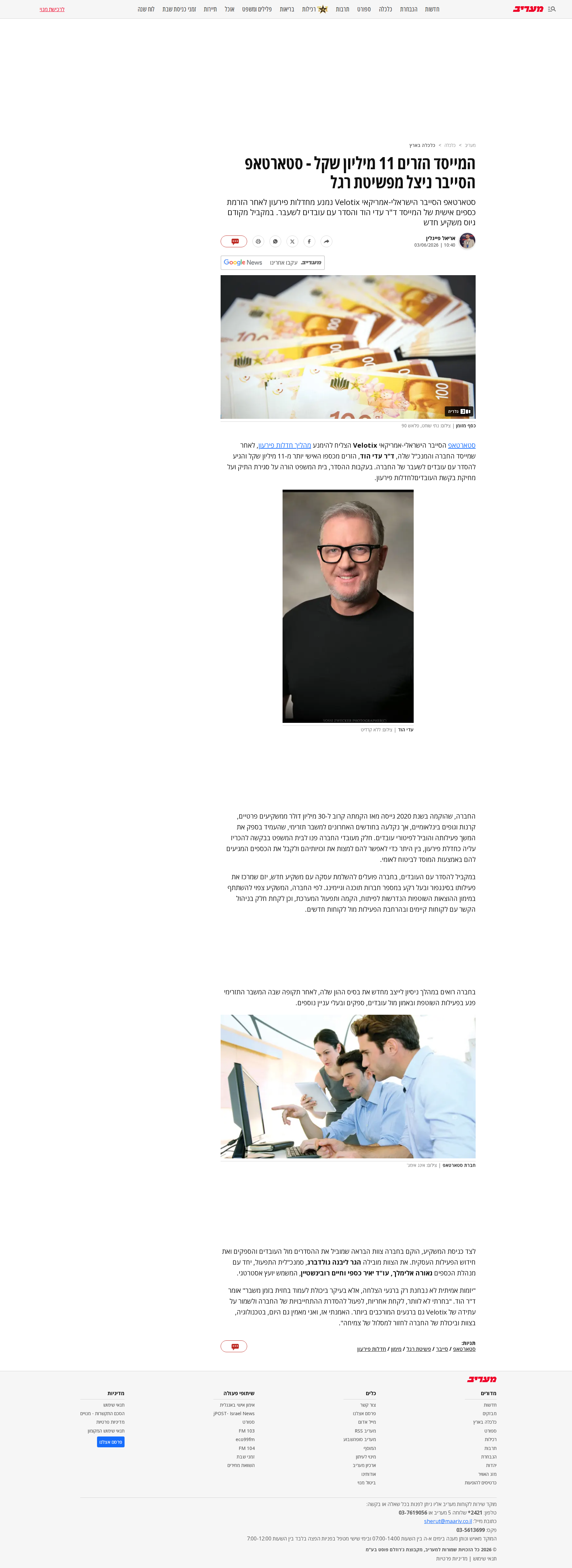
On 3 June 2026, the financial section of Maariv carried the good news under the byline of Ariel Feiglin:
The founder injected 11 million shekels — the cyber startup avoided bankruptcy
Velotix, the story reported, had “succeeded in avoiding an insolvency proceeding,” after founder and CEO Dr Adi Hod “injected more than 11 million shekels of his own money” and reached a settlement with former employees. The court had closed the case and struck the petition. A new investor — an entrepreneur “who centres his activity in Singapore” with “a background in several software and gaming companies” — was being lined up to fund operations. A recovery team had been assembled. Dr Hod was quoted directly:
“Real entrepreneurship is tested not only in moments of success, but mainly in the ability to stand at the front during a crisis. I chose not to give up, to take responsibility, to act to settle the company’s obligations and to safeguard Velotix’s future even in the most complex moments.”
It is a stirring account. It is also, from first line to last, the company’s own — a single byline, a founder’s quote, a named “recovery team,” and a forthcoming investor whom no one is invited to name. The reader who has followed the previous four parts of this series may find the gap between the telling and the record worth a closer look.
How It Was Published
The article ran on 3 June 2026 in Maariv’s economics section, כלכלה בארץ, under the byline of Ariel Feiglin. It is not flagged as sponsored content: the page’s own data marks it isSponsored: false, and it carries none of the תוכן שיווקי (“marketing content”) labelling that, in Part 3, accompanied the Calcalix page promoting the very same angel round. It ran as news.
What it reports, it reports on the company’s account. The only named source is Dr Hod, and the only quote is his. No comment appears from the thirteen petitioners or their counsel, from the suppliers who sued, or from the Ministry of Labour that found the seven violations — the parties on the other side of the “settlement” the article describes. The eleven million shekels, the unnamed investor, the closing of the case: each is given as the company gives it.
This is context, not accusation. Feiglin is Maariv’s economics correspondent — by his own profile an economist by training, covering macroeconomics, the capital markets, the state budget and financial innovation. A packaged announcement — a founder’s quote, a named recovery team, an investor still to come — lands more softly on a general economics desk than on the labour-courts beat that produced the original reporting. The TheMarker story that opened this series was built on a court petition. Maariv’s reads as though it were built on a press release.
What the Story Does Not Mention
The Maariv piece runs to several hundred words. In them, Velotix is a company that hit a “cash-flow crisis,” parted with some staff, and is now stabilising under the steady hand of a founder digging into his own pocket.
It does not mention the Ministry of Labour’s finding, five weeks before the angel campaign, that Velotix had violated seven separate labour laws. It does not mention that the company deducted pension contributions from employees’ salaries and did not transfer them to the funds — conduct that, under Israeli law, can constitute criminal misappropriation. It does not mention the January 2026 angel round sold to thirty-five investors at 100,000 NIS a head, or the ISA-licensed platform that distributed it, or the claim — circulated on the same campaign — that Dr Hod had “registered exits of over $100 million.” It does not mention the DMCA notice filed from Chittagong, citing an unrelated article about a former finance minister, that tried to remove Part 1.
A comeback story is entitled to its omissions. The reader is entitled to notice them.
“His Own Money”
The headline number is eleven million shekels, “of his own money.”
Readers of Part 2 will recall that Dr Hod’s only identifiable prior exit — Euclides Technologies — sold for approximately $200,000, against the “$100 million” the marketing claimed. Readers of Part 1 will recall the WhatsApp message he sent an unpaid consultant in 2025: “There is no company. It’s a shame about the effort. We’re closing because investors didn’t bring in money.” They will also recall that First International Bank of Israel holds a first-priority lien over Velotix’s cash deposits.
Where, one might ask, does a founder who told a creditor there was no company, whose flagship exit realised a fifth of a million dollars, and whose corporate cash is pledged to a bank, find eleven million shekels of his own to inject? Maariv does not say, and does not appear to have asked. The figure is offered, and reported, on the founder’s word.
It is, at least, a familiar word. In March 2026, responding to TheMarker, Velotix said the CEO “is personally financing the company’s operations to ensure business continuity.” Three months on, the personal financing has acquired a number and a press cycle.
“Avoided Bankruptcy”
The insolvency the founder is said to have averted was not a hostile act of nature. It was the petition (חדל"ת 60765-02-26) filed in February 2026 by thirteen former employees and managers — among them co-founder Uriel Ekstein, who according to that petition had gone unpaid for half a year before being fired — seeking to wind the company up so that they might recover, through the National Insurance Institute, wages and pension monies Velotix had not paid them.
“Avoiding insolvency,” then, means reaching a settlement with the people the company had not paid, such that they withdrew the petition and the court closed the file. The closure is reported by Maariv; the terms of the settlement are not disclosed. A man is being congratulated, in other words, for settling debts to employees that the Ministry of Labour had already found him in breach of the law for leaving unpaid. The rescuer and the cause of the wreck are the same person.
The Unnamed Investor
The new money, Maariv reports, will come from “an entrepreneur who centres his activity in Singapore” with “a background in several software and gaming companies.” He is not named. The amount is not stated. The deal is, as of the report, not closed.
Singapore recurs in this story. Dr Hod, by his own LinkedIn account, divides his time between New York, Singapore and Tel Aviv; Part 1 records his habit of flying first class to Thailand and Singapore for what were described as investor meetings while an employee was routed through Addis Ababa in economy. Sarona Ventures’ TechShield platform listed the Singapore payments firm Liquid Group among Velotix’s “customers.” The geography is not new.
The investor, however, cannot be found. A search of public records and the press turns up no name, no firm, and no Singaporean software-and-gaming entrepreneur associated with Velotix or Dr Hod. Investors who were once promised “the next generation of Israeli cyber successes,” and were told the CEO had “registered exits of over $100 million,” may wish to ask for rather more about the rescuer from Singapore than that he exists.
The Recovery Team
The story names a turnaround team: Hagar Livne Goldberg as COO, Naora Elimelech as CFO, the advocate Yair Caspi, and Chaim Rubinstein as “strategic advisor.”
A search of LinkedIn, the press and the company registry returns no public footprint connecting any of the four to Velotix, and little connecting some of them to anything. This proves nothing in itself — recovery specialists are not obliged to maintain a web presence. It is noted only because the company that filled its marketing with a CEO’s $100 million in phantom exits and its “About” page with a co-founder it had already fired has not always introduced its personnel with their real particulars.
Thirty Million, Again
Maariv repeats, without qualification, that Velotix “has raised close to $30 million since its founding.”
This figure has now been asserted at three different values by the company itself. At the Calcalist Mind the Tech conference in March 2025, Dr Hod said “over $30 million”; the Dream Team profile Velotix submitted to the same conference said $23 million; the October 2022 seed announcement said $10 million. Tracxn, independently, records $10 million. The known unpaid debts to employees and suppliers came to roughly 1.4 million NIS; the Delaware parent was carrying $43,000 in unpaid franchise tax. The arithmetic of where $30 million went was never reconciled in Part 1, and is not reconciled now. It is simply restated.
The Spin Runs on a Loop
Compare two passages. The first is Velotix’s response to TheMarker, March 2026: the company “is in a renewed growth process and is advancing arrangements with suppliers and employees as part of a process to stabilize and strengthen business operations.”
The second is Maariv, June 2026: the company “sees the move as an attempt to re-stabilise its capital base,” having set up a recovery team “to lead the arrangements with employees and suppliers and the renewal of business activity.”
Renewed growth, arrangements with employees and suppliers, stabilisation. Three months apart, two publications, one paragraph.
The Registry’s Account
The Registrar of Companies keeps its own version, and it is a matter of public record: anyone may pull Velotix’s company extract (נסח חברה) for twelve shekels. Pulled on 5 June 2026 — two days after the comeback ran — it does not read like a rehabilitation.
The company is still listed as active, but on 26 May 2026, eight days before Maariv published, the Registrar issued a warning before registration as a violating company (התראה לפני רישום חברה מפרה). The most recent annual report on file is still the one for 2023 — the delinquency first noted in Part 1 — and the company owes the Registrar 1,777 shekels in unpaid fees. The renewal of business activity has not, as yet, extended to filing an annual report.
The capital account is barer still. A founder said to have injected eleven million shekels has issued no new shares to show for it: the allotted share capital stands where it stood, at 14,613.91 shekels, and the sole registered shareholder remains the Delaware parent, Velotix Inc. Several routes would leave no trace here — money advanced as a shareholder loan, or paid into the Delaware parent rather than the Israeli subsidiary, would not show on this extract. But a loan is not eleven million shekels of capital; a loan advanced to a company whose cash is already pledged to a bank is a curious sort of rescue; and the entity that owed the wages, carries the lien and faced the winding-up petition is the Israeli one — whose books record no new capital at all. Whatever the eleven million is, the registry of the company it was meant to save does not record it as equity.
Nor has the rescue reached the parent. Velotix Inc — the Delaware company that owns the Israeli one — was already delinquent on its franchise tax when Part 1 went to press, owing $43,055.82 as of 2 March 2026. By the time the comeback was published, the figure had grown: the Delaware Division of Corporations’ entity record, retrieved on 5 June 2026, gives a status of “AR Delinquent, Tax Due” and tax owing of $60,932.62. In the very months the founder is said to have found eleven million shekels for the company, the unpaid tax bill on its own parent rose by nearly eighteen thousand dollars.
For the cash is pledged, and the pledge is live. Under active charges, the extract lists a single first-priority fixed charge — 125,000 shekels over Velotix’s bank deposits and securities, in favour of First International Bank of Israel, registered on 29 January 2024 and still in force on 5 June 2026. It carries a negative pledge: the company may not deal with the secured monies without the bank’s consent. The lien Part 1 reported is not history. It is current.
And the recovery team is not in it. The extract names one officer of the company — its director, Dr Adi Hod, in post since incorporation in September 2020. Hagar Livne Goldberg, Naora Elimelech, Yair Caspi and Chaim Rubinstein hold no registered office. They may be advisors or employees, whom the registry would not list; but the turnaround Maariv describes had, as of the day the comeback was published, added not one name to the company’s roll of officers.
The same extract is, in one respect, a corrective to the sceptic. It confirms that the technology was always real: a granted Israeli patent (no. 286186, “System and Method for Managing Data Access Requests”) and a registered VELOTIX trademark. The product exists. It is the accounting around it — the thirty million raised, the eleven million injected, the rescuers no record can find — that the registry declines to corroborate.
So
A company found in breach of seven labour laws, whose pension deductions never reached the funds, which marketed angel investments on a fivefold-inflated exit record while its employees went unpaid, and which then watched a fraudulent takedown notice arrive from Bangladesh, has now been written up as a story of resilience — eleven million shekels of the founder’s own money, an unnamed saviour in Singapore, a court case closed.
The product, as Part 1 noted, was real enough: a tool for managing database access. The technology is not the question. The question, as ever, is the distance between what Velotix says and what the documents say — and whether the thirty-five angel investors, the unpaid suppliers, and the employees who had to petition a court to recover their own wages will read the comeback the way Maariv wrote it.
The full Maariv article is preserved as text and as a screenshot in this post, against the day it too is quietly deleted.
This is Part 5 of the Velotix Files. Part 1 covers the full investigation. Part 2 profiles the CEO. Part 3 examines the marketing machine. Part 4 documents the DMCA takedown notice.